

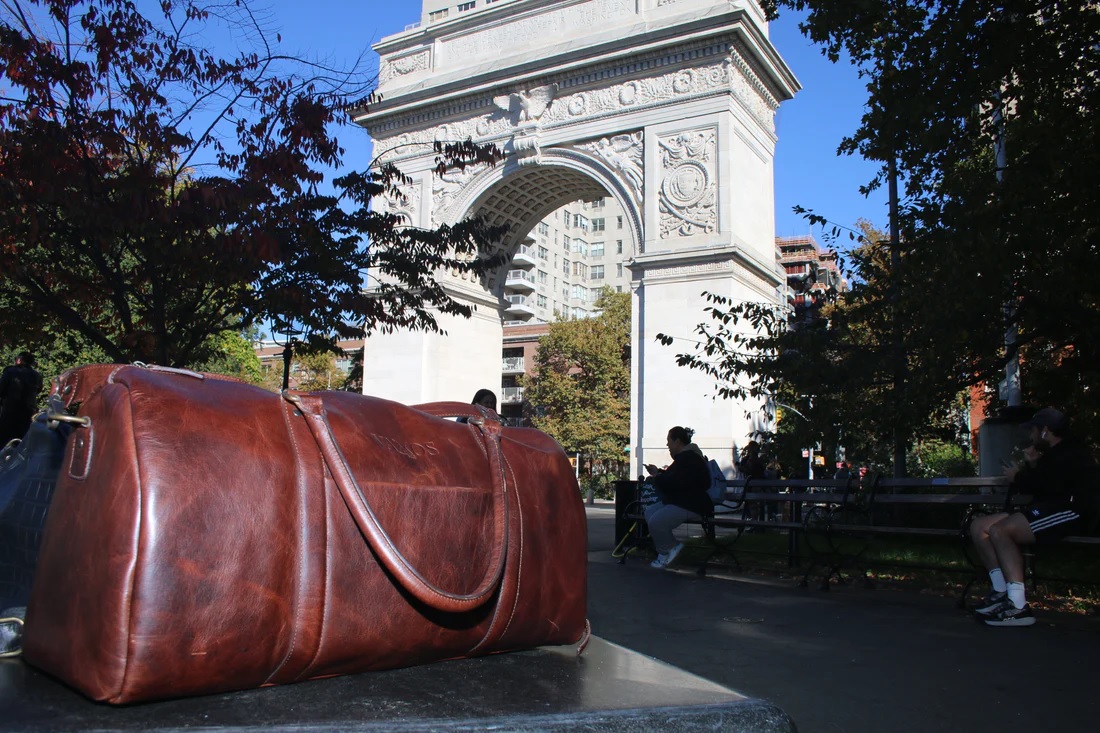
A handmade leather duffle bag is a travel bag crafted by skilled artisans using hand-cutting, hand-stitching, and manual assembly techniques — where every panel is individually cut, every seam is sewn using the saddle stitch method with two needles, and every edge is hand-burnished and sealed — producing a bag with structural integrity, stitch reliability, and individual character that factory-assembled alternatives cannot replicate regardless of price.
The structural difference between handmade and machine-made is not aesthetic preference — it is engineering. Hand saddle stitching uses two needles passing through the same hole from opposite sides, creating a stitch that locks independently at every point. If one stitch breaks, the adjacent stitches hold firm. Machine chain stitching uses a single thread in a looping pattern — if one loop fails, the entire seam can unravel progressively from the failure point. For a travel bag that encounters zipper stress, strap loads, and packing pressure on every trip, this difference determines whether the bag lasts 5 years or 25.
This guide explains what handmade construction means in practical terms, how to identify genuine artisan work versus factory products marketed as ‘handcrafted,’ and why the Rajasthani leather tradition produces some of the world’s best value artisan leather duffle bags.
Every bag in the Rustic Town handmade leather duffle bag collection is crafted in Rajasthan workshops by artisans with 15+ years of leatherworking experience.
What Makes Handmade Construction Structurally Superior for Travel Bags?
| Element | Handmade / Artisan | Factory / Machine |
| Stitching | Saddle stitch — two needles, self-locking | Chain stitch — progressive unravelling risk |
| Stitch tension | Adjusted per section and stress point | Uniform — cannot adapt to curves |
| Leather selection | Each panel individually chosen for grain and thickness | Batch-cut from mixed quality sections |
| Edge finishing | Hand-burnished with beeswax, smooth and sealed | Machine-cut, raw or plastic-coated |
| Hardware | Hand-riveted with reinforcement leather backing | Machine-pressed with minimal backing |
| Quality control | Artisan inspects every piece personally | Statistical sampling on production line |
| Production time | 12–20 hours per duffle bag | 30–60 minutes per bag |
A travel duffle takes more cumulative stress than almost any other leather product. Strap attachments bear 8 to 15 kg of hanging weight. Zippers compress and expand hundreds of times. The base panel absorbs floor contact, moisture, and abrasion on every trip. Saddle stitch construction at these stress points is not a luxury — it is the engineering standard that makes long-term durability possible.
How Can You Tell If a Leather Duffle Bag Is Genuinely Handmade?
Stitch variation under close examination.
Genuine hand stitched duffle bag construction shows subtle, consistent variation in stitch spacing — not sloppy, but not robotically identical. Machine stitching is mathematically uniform with zero variation across every seam.
Burnished edges with natural wax seal.
Hand-burnished edges feel smooth and warm with a natural sheen. Machine-cut edges are sharp and often coated with a visible plastic sealant that cracks within 1 to 2 years.
Artisan identification and workshop origin.
Genuinely handcrafted leather travel duffle brands identify their artisans, specify workshop locations, and describe construction methods. Generic claims of ‘handcrafted quality’ without specifics almost always describe factory products.
Where Are the Best Handmade Leather Duffle Bags Produced?
| Region | Tradition | Known For | Price Range |
| Rajasthan, India | 500+ years of leathercraft | Full-grain buffalo leather, saddle stitch, travel goods | $100–$350 |
| Florence, Italy | Renaissance leather guilds | Luxury vegetable-tanned goods | $400–$1,500+ |
| Fez, Morocco | Centuries-old tanneries | Hand-dyed leather, traditional construction | $80–$300 |
| León, Mexico | Major leather production | Tooled and carved leather | $60–$250 |
Rajasthan delivers the strongest value in handmade leather travel goods. The artisan tradition produces construction quality comparable to Italian workshops at 25 to 40% of the price, using identical saddle stitch techniques and vegetable-tanning methods refined over centuries.
How Do You Care for a Handmade Leather Duffle Bag?
Handmade duffle bags typically use vegetable-tanned or oil-finished full-grain leather. Condition every 4 to 6 months with a beeswax or plant-based leather balm. Avoid silicone products that seal the surface and block patina development.
After every trip, wipe the exterior with a damp cloth to remove travel dust, conveyor belt residue, and salt. Store stuffed with tissue in the cotton dust bag included with most artisan purchases. The bag’s shape memory depends on proper storage between uses.
Frequently Asked Questions: Handmade Leather Duffle Bags
Q: What is a handmade leather duffle bag?
A: A travel bag crafted by skilled artisans using saddle stitch hand-sewing, manual cutting, and hand-burnished edges — structurally superior to factory production with a lifespan 2 to 3 times longer.
Q: Why are handmade duffle bags more expensive?
A: A handmade duffle requires 12 to 20 hours of skilled artisan labour versus under an hour for factory production. The leather is also typically higher-grade full-grain material.
Q: How long does a handmade leather duffle bag last?
A: 20 to 30+ years. The saddle stitch construction is self-locking — individual stitch failures do not cause progressive seam unravelling.
Q: Are Rustic Town duffle bags genuinely handmade?
A: Yes. Every Rustic Town duffle is handcrafted in Rajasthan using saddle stitch construction, hand-cut full-grain leather, and manually set brass hardware.
Browse the full Rustic Town artisan leather duffle collection — genuinely handcrafted in Rajasthan.
Also see the handcrafted leather travel duffle range for additional travel-ready models.